
In Fall 2025 at Agnes Scott College, upper-level Creative Arts students are pursuing a semester long research project on an artist’s work of their choosing. The purpose of the course is to develop strong research skills and experience, as well as exploring work that personally interests us. We have been tasked with delving into a wide array of academic materials on our artist and their work, so that we can narrow down our findings into specific and comprehensive research.
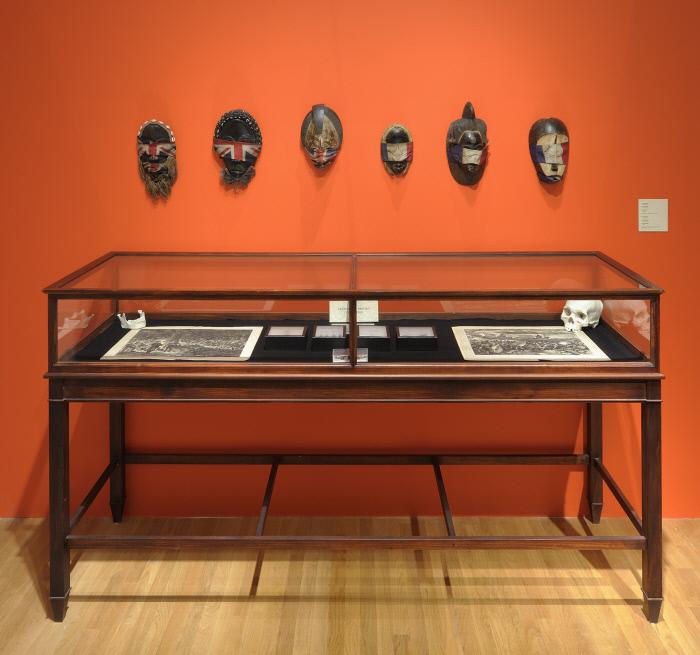
My chosen artist for this semester is Fred Wilson and I decided to research his 1990 piece Colonial Collection from his exhibition The Other Museum (1990-1991). In my research for this work, I discovered the fascinating thematic and artistic boundaries pushed by Wilson.
Here’s what I’ve found so far:
In the early 1990s, scholars began approaching Fred Wilson’s work with eyes trained on his ability to crack open the dialogue surrounding representation in museum practices. These scholars understood his early work to be deliberate recontextualizations of objects and parodies of flawed installations that confronted the prejudiced inner workings of the museum world. They connected his work to conceptual artists who also engaged with material culture and challenged the functions of museums, like Marcel Duchamp and Robert Smithson. Some scholars viewed Wilson’s work as an extension of the site-specific practices of Smithson, and others touched on Duchamp to contextualize material culture as an approach for understanding Wilson. Additionally, they pointed to the ways in which Wilson’s subject matter addressed the problematic colonial practices and cultural othering perpetuated by Western institutions.
In the 2000s and 2010s, scholarship continued to draw on the groundbreaking success of Wilson’s Mining the Museum and additional exhibitions during the 1990s to situate his more recent work. In his newer work, they address a shift in focus from the institution to, more singularly, the objects themselves. However, Wilson’s thematic interests, as these scholars discuss, are consistent across his career and each exhibition builds on the work of the last. In recent scholarship on Wilson’s work, every scholar seemingly found it impossible to discuss his new work without outlining the compounding progression of Wilson’s methods, ideas, and focuses.
Discussions of Colonial Collection (1990) are primarily resigned to utilizing the piece for comparison and supporting evidence in a larger argument, or the scholar chooses to focus on just one aspect of the piece. So, my research up to now has left me in an interesting position: I can summarize academic conversations surrounding Fred Wilson, and I now have room to expand research on Colonial Collection (1990).
Image: Fred Wilson, Colonial Collection, 1990, Wooden masks, flags, insects, human skull, feather, labels, 19th century prints, glass and wood vitrine, Nasher Museum of Art at Duke University